

Georges Rouault: Memories of the Artist’s StudioClosed

Georges Rouault: Memories of the Artist’s Studio

To those who wish to visit the "Georges Rouault: Memories of the Artist’s Studio" exhibition,
time-specific reservations are required for visits on Saturdays, Sundays, and national holidays.

Reservations will begin at 10 a.m.  on Wednesday, April 1.

Exhibition Overview

Since its opening in 2003, the Panasonic Shiodome Museum of Art has acquired works by Georges Rouault, one of the preeminent French painters of the 20th century. At present, the museum contains approximately 270 of the artist’s works. This exhibition introduces the institution’s Rouault collection with an emphasis on newly acquired works. Focusing on the artist’s studio as the birthplace of his art, the exhibition considers the environment and the materials that gave rise to Rouault’s paintings while introducing important works spanning his career. In addition, one section of the display space attempts to partially reproduce Rouault’s last studio, dating from his later years, through the use of his actual painting materials, desk, and other items. Don’t miss this special opportunity to unravel memories of the artist’s studio, a sacred space that remained off limits even to Rouault’s closest family members.

Dates
Saturday, April 11 – Sunday, June 21, 2026
Hours
10 a.m. – 6 p.m. (Open until 8 p.m. on May 1 and June 5, 19, and 20, 2026)
Admittance until 30 minutes before closing time.
Closed
Wednesdays (Except for April 29, May 6, and June 17)
Admission
Adults: ¥1,200
Visitors aged 65 or over carrying proof of age : ¥1,100
Students (High school and college): ¥700
Admission is free for children in middle school or younger.  Admission is free for disability passbook holders and up to one accompanying adult.  
Admission will be ¥500 for all visitors on International Museum Day (Monday, May 18).
Organized by
Panasonic Shiodome Museum of Art, The Asahi Shimbun
Supported by
Ambassade de France au Japon / Institut français du Japon, Minato City Board of Education
Special cooperation by
Fondation Georges Rouault

Exhibition Highlights

1.A chance to view many new additions to our collection

Ever since the founding of the Museum, we have continued to grow our collection of works by Georges Rouault. However, in 2022, we began to expand the breadth of our collection with our first acquisition of an oil painting by Gustave Moreau, Rouault’s mentor. More recently, in 2024, we acquired Two prostitutes (1906, with Portrait of a woman on the reverse), which is wonderfully representative of Rouault’s Fauvist period. This exhibition will offer visitors the chance to see these and other recent acquisitions. One work, The Model, Memory of the Studio (1895/c.1950), will be on exhibit for the first time since joining our collection.
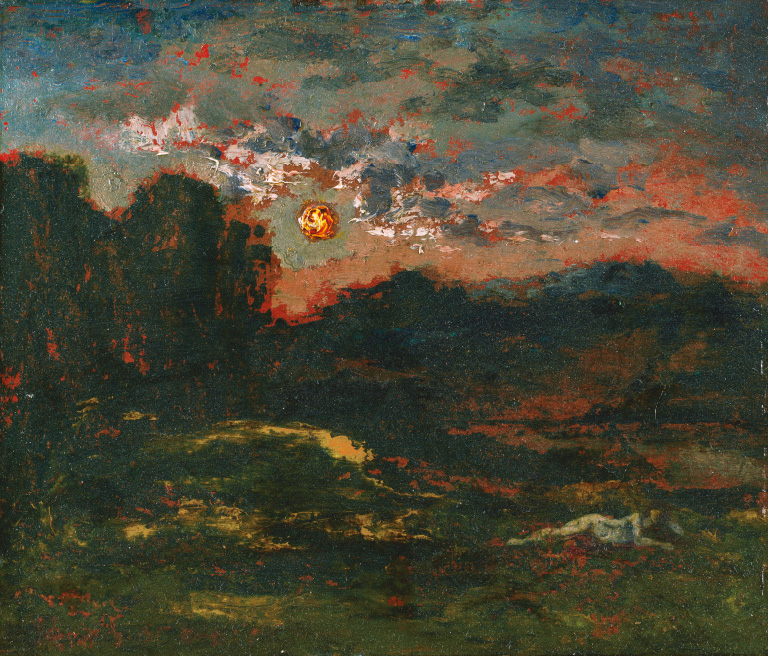
Gustave Moreau
Pain of Orpheus or Orpheus weeping on the ground (study) / Douleur d'Orphée, dit aussi : Orphée pleurant à terre (étude)
Ca.1891
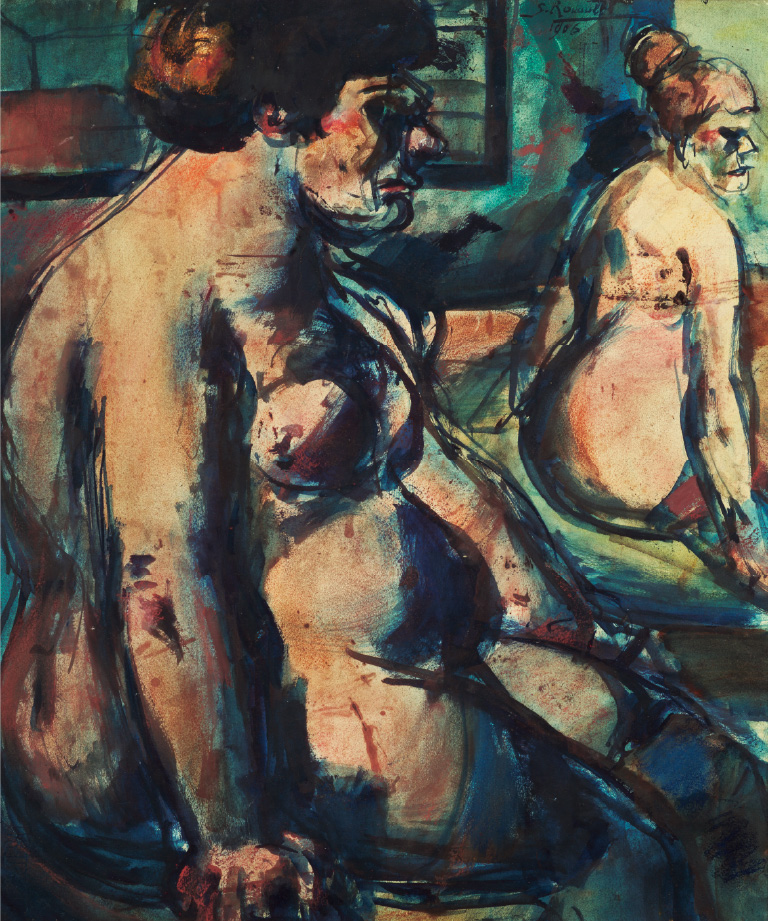
Georges Rouault
Two prostitutes / Deux prostituées
1906
ⒸADAGP, Paris & JASPAR, Tokyo, 2026 E6257

2.Masterpieces from throughout Rouault’s career and the places where he made them

This exhibition will divide Rouault’s artistic career into four broad periods, showcasing archetypal works from each period alongside representations of the places where they were created. These works will demonstrate how Rouault’s unique creative style was constantly changing and evolving across these different periods. One such piece, and a new addition to our collection, is The Model, Memory of the Studio. First painted in 1895, it was later painted over in the 1950s. This is one of several early works that Rouault revisited later in life and repainted as a kind of memory, which will be a highlight of this exhibition.
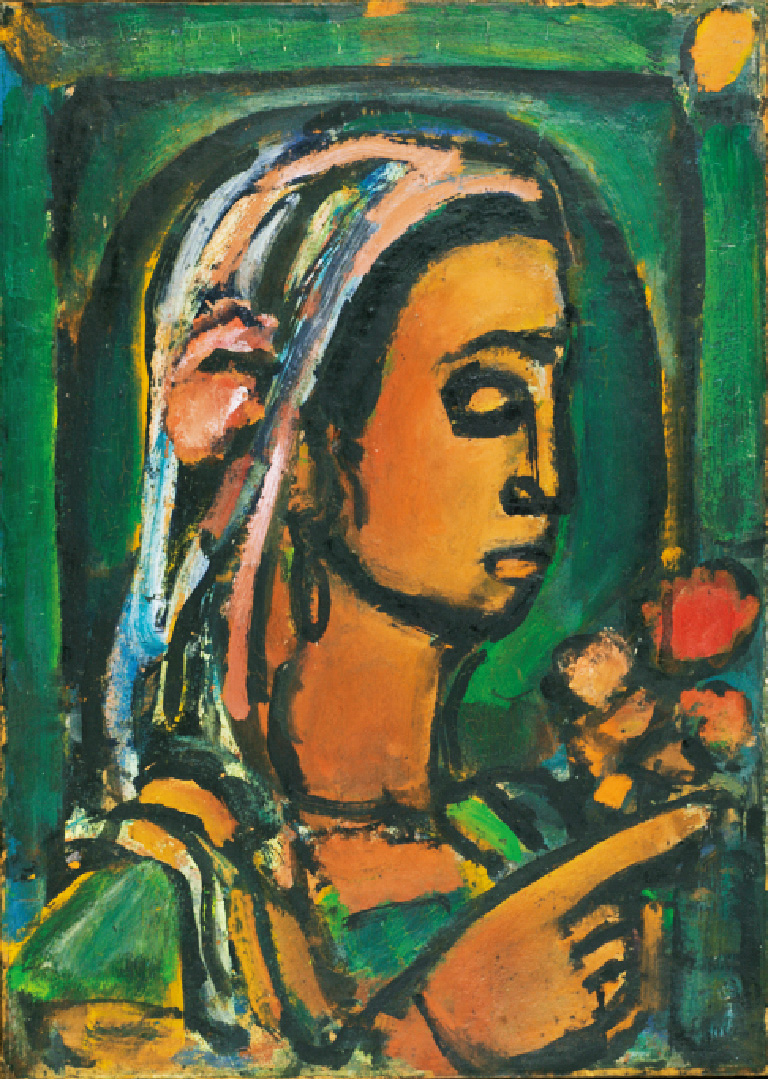
Georges Rouault
The Sibyl of Cumae / La Sibylle de Cumes
1947
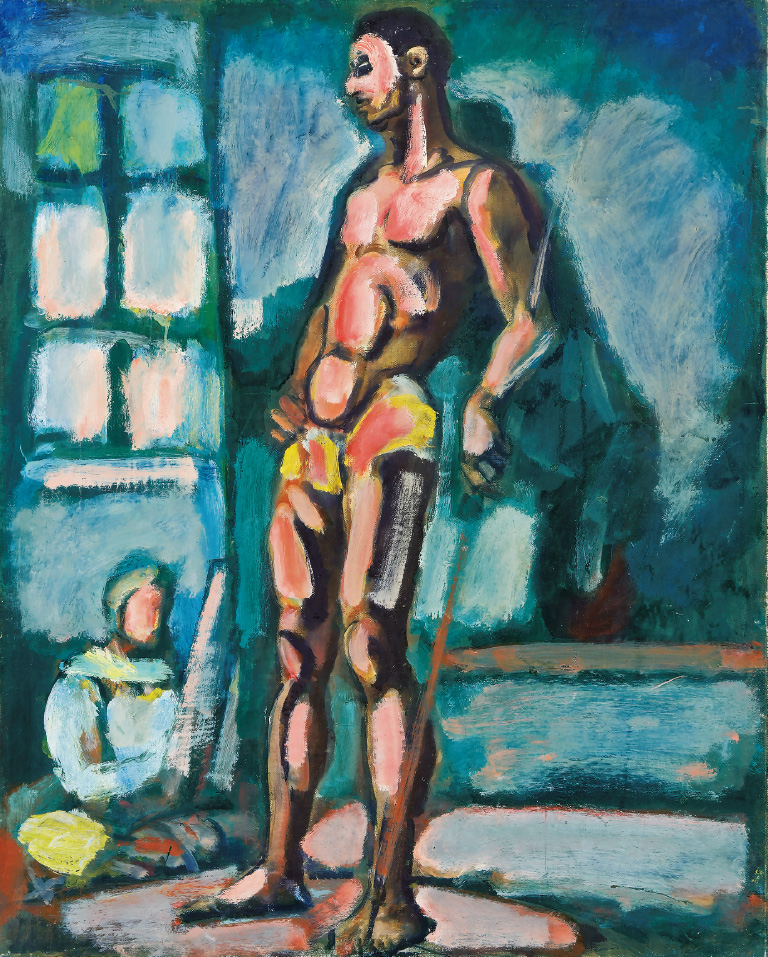
Georges Rouault
Le modèle, souvenir d'atelier / The Model, Memory of the Studio
1895/c.1950

3.Premiering in Japan: A partial reproduction of Rouault’s last studio

In 1948, Rouault moved into what would be his final atelier at 2 rue Émile Gilbert, across from the Gare de Lyon in Paris’s 12th arrondissement. The building is now home to the Georges Rouault Foundation, which has preserved his studio untouched. With the Foundation’s kind cooperation, we will be able to partially recreate his studio and populate it with art materials actually used by Rouault. Arranged to capture the atmosphere of the studio when it was still in use, these materials and tools rarely leave the actual atelier and have never been exhibited in Japan. It will be a unique opportunity not to be missed.
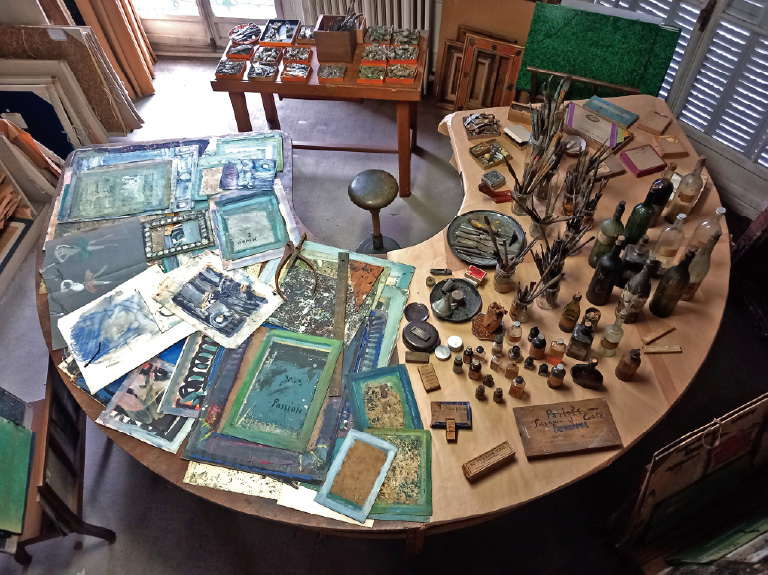
Rouault’s Parisian studio in its current state, which will be partially recreated for this exhibition
Photo: Fondation Georges Rouault © Cyril Preiss

Georges Rouault (1871-1958)

Rouault was born and raised in the working-class Parisian neighborhood of Belleville. At the age of 14, he apprenticed under a stained glass craftsman while attending evening classes at the École des Arts Décoratifs. In 1890, when he was 19, he entered the École des Beaux-Arts, where he studied under Jules-Élie Delaunay (1828–1892) and then under Gustave Moreau (1826–1898). Moreau’s respect for the individuality of his students above all else attracted such artists as Henri Matisse (1869–1954) and Albert Marquet (1875–1947), with whom Rouault enjoyed close friendships. After Moreau’s death, Matisse, Marquet, and Rouault helped found the Salon d’Automne, for which they produced a great number of innovative works. In the 1890s, Rouault found himself deeply impressed by the work of Paul Cézanne (1839–1906) upon viewing it at the Ambroise Vollard gallery. The influence of Moreau and Cézanne gradually inspired Rouault to strive for harmony between form and color; he frequently invoked the phrase “form, color, harmony” when writing about his art. While he is best known for his works on Christian themes, he also created many pieces that capture the essence of humanity in ordinary people, from circus performers and prostitutes living on the bottom rung of society to judges who held positions of authority. He continued painting even after temporarily fleeing Paris during both world wars, an experience that inspired him to produce works on the theme of war, most famously the print series Miserere. In his later years, Rouault painted many portraits and landscapes full of luminous colors and a distinctive use of thickly layered paint.

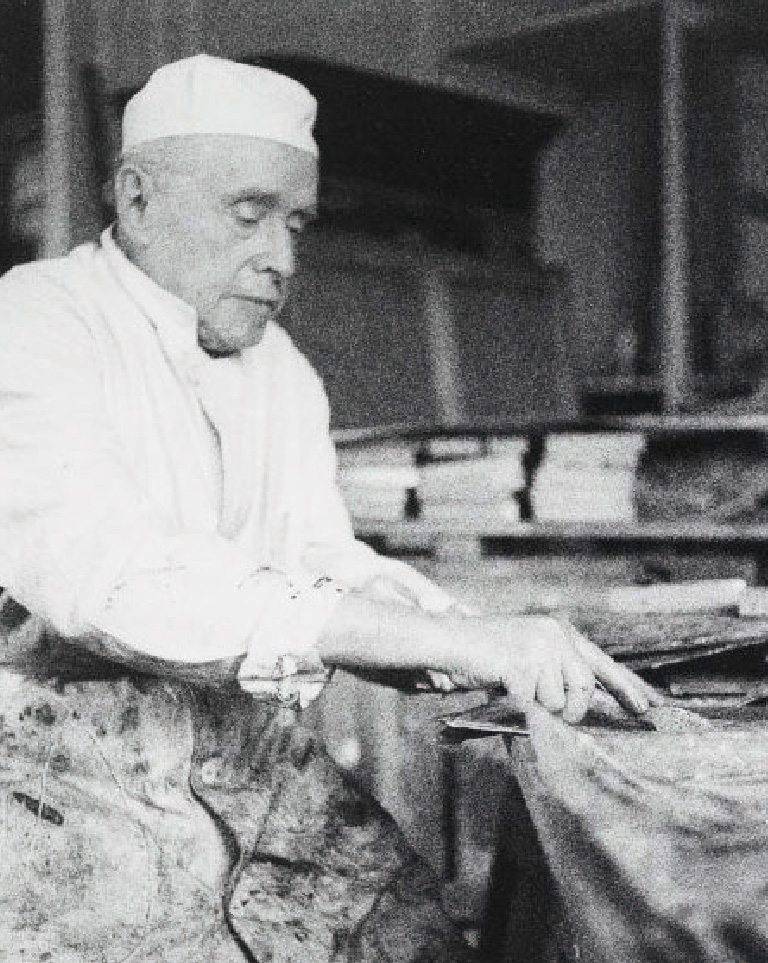
Rouault at work in his Paris atelier in 1953
Photo: Yvonne Chevalier