

Hasegawa Kiyoshi: The Trajectory of a Paris-based Printmaker
(Works from the Machida City Museum of Graphic Arts Collection)
Closed

Hasegawa Kiyoshi: The Trajectory of a Paris-based Printmaker

To those who wish to visit the "Hasegawa Kiyoshi: The Trajectory of a Paris-based Printmaker" exhibition, time-specific reservations will be required for visits on Saturdays, Sundays, and national holidays from August 29 to September 23. (No reservations will be required for weekday visits.)

Exhibition Overview

After the First World War, Hasegawa Kiyoshi (1891–1980), one of Japan’s preeminent print artists, moved to France, where he remained for the rest of his life. In his own unique way, Hasegawa made a huge impact on the history of printmaking by reviving the traditional copper printing technique of manière noire (mezzotint), which was then on the verge of dying out. He also explored various other techniques such as engraving and aquatint, creating a body of profound and spiritual monochrome expression that continues to attract people even today.
Although Hasegawa exerted a strong influence on Japanese printmaking, his practice was rooted in Paris. In the 1920s, as he coming into his own as an artist, Hasegawa discovered the work of the painter and printmaker Raoul Dufy, and joined in the Société des Peintres-Graveurs Indépendants, which included artists such as Henri Matisse, Pablo Picasso, and Marc Chagall. Hasegawa also went to great lengths to introduce French audiences to Japanese traditional prints, and created engravings for an edition of the literary classic Taketori monogatari (The Tale of the Bamboo Cutter). In addition to pre-19th century prints that influenced the artist and works by his contemporaries in Paris, this exhibition presents a host of Hasegawa’s career-spanning masterworks drawn primary from the Machida City Museum of Graphic Arts, home to one of Japan’s leading collections of Hasegawa Kiyoshi’s art.

Dates
Saturday, July 11 – Wednesday, September 23, 2026
Hours
10 a.m. – 6 p.m. (Open until 8 p.m. on August 7, September 4, 18, and 19, 2026)
Admittance until 30 minutes before closing time.
Closed
Wednesdays (Except for Sep. 23), August 10 - 14
Admission
Adults: ¥1,200 (¥1,000)
Visitors aged 65 or over carrying proof of age : ¥1,100 (¥900)
Students (High school and college): ¥700 (¥500)
Admission is free for children in middle school or younger.
Prices in parentheses are for tickets purchased on the Museum website, valid July 11 – August 28.
Admission is free for disability passbook / Mirairo ID holders and up to one accompanying adult.
Organized by
Panasonic Electric Works Co.,Ltd. Panasonic Shiodome Museum of Art, The Tokyo Shimbun
Co-organized by
Machida City Museum of Graphic Arts
Special Cooperation by
Yokohama Museum of Art
Supported by
Minato City Board of Education

Exhibition Highlights

1.A Wealth of Masterworks by Hasegawa Kiyoshi

For the first time, the Machida City Museum of Graphic Arts presents its celebrated collection of works by Hasegawa Kiyoshi outside the museum. The exhibition surveys his career, from the lucidly composed early works made before he left for France, through the years of inquiry in Paris when his study of copperplate techniques honed the artistry of his line, to the late mezzotints, whose depths of black are charged with silent spirituality.

2.A Vivid Picture of Hasegawa’s Life in Paris

Hasegawa began his career as a printmaker in 1920s Paris, where he joined the Société des Peintres-Graveurs Indépendants at the invitation of the painter and printmaker Raoul Dufy. Alongside his work of this period, the exhibition presents outstanding contemporaneous works by painters in his circle, including Henri Matisse, Raoul Dufy, Jean-Émile Laboureur, and André Dunoyer de Segonzac.

3.The French Edition of Taketori monogatari (The Tale of the Bamboo Cutter) in Its Entirety

Hasegawa’s French edition of Taketori monogatari (The Tale of the Bamboo Cutter) is a masterpiece of the illustrated book medium, fusing Japanese tradition and Western culture. Its engraving and drypoint illustrations unfold with stately refinement, their crisply incised lines creating an atmosphere of dignity and grace. This exhibition offers a rare opportunity to see the complete suite (illustrations printed on separate sheets), which was included only in the deluxe edition.
Prologue
Years in Japan: A Voice from Beyond Water and Sky

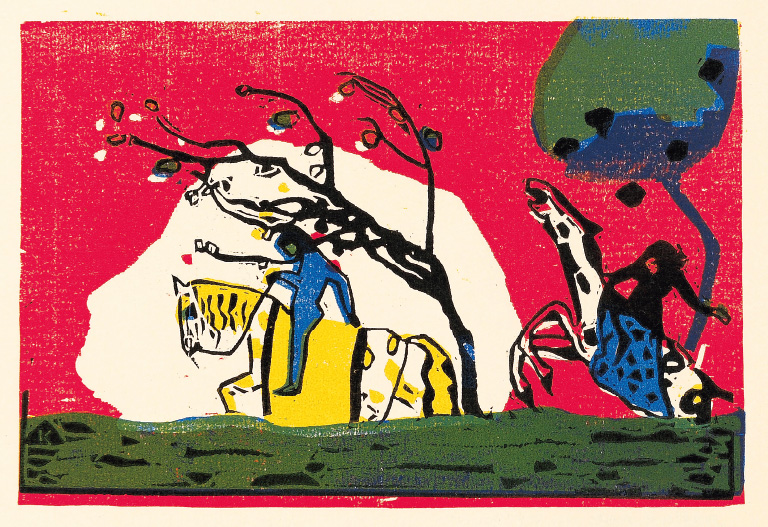
Hasegawa Kiyoshi was born in Yokohama in 1891, and from boyhood he gazed at the foreign ships coming and going in the harbor and dreamed of distant lands. This section features covers and frontispieces he began producing for literary magazines in 1913, alongside prints by Odilon Redon, Wassily Kandinsky, William Blake, and other artists who influenced him.

Wassily Kandinsky
Two Riders against a Red Background, from the artist's book Sounds
Woodcut, 1911; published in 1913

1. Mastering Copperplate Printmaking: Discovering and Revitalizing Classical Techniques

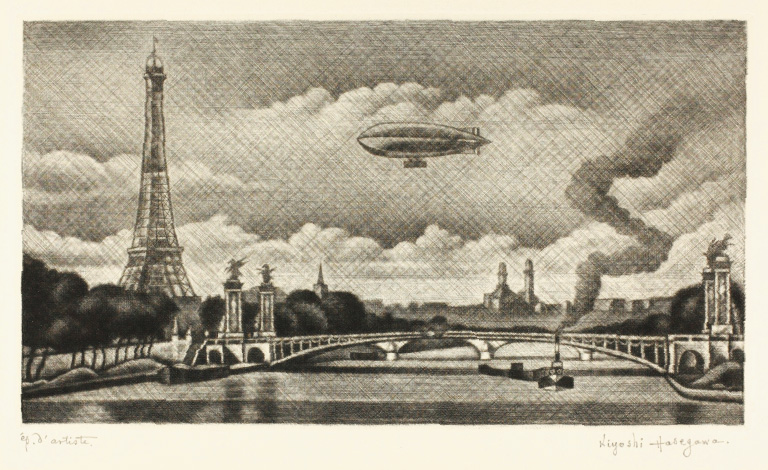
In 1919, Hasegawa moved to France to study copperplate printmaking. There he mastered advanced techniques such as engraving, in which the plate is incised with a burin, and revitalized the classical technique of manière noire (mezzotint), then falling into disuse, through an approach entirely his own. This section presents Hasegawa’s works categorized according to technique.

Kiyoshi Hasegawa
Alexander III Bridge and a French Dirigible
1930/ Mezzotint
Machida City Museum of Graphic Art

2. Printmaking in Paris: Friendships with Fellow Artists

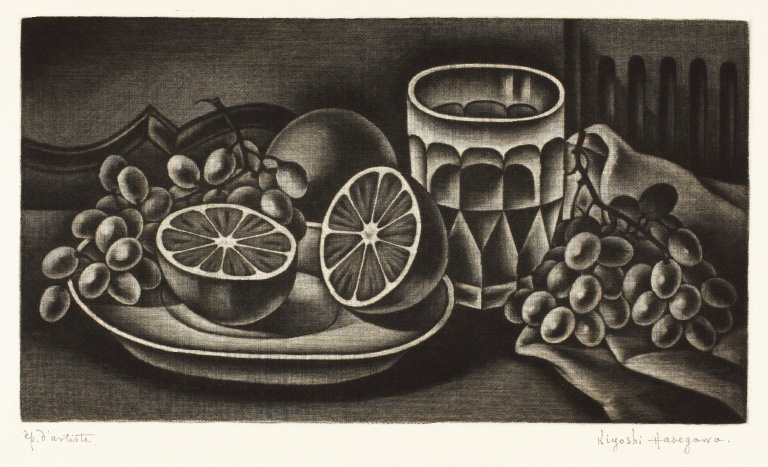
n the early 1920s, Hasegawa met the Fauvist painter Raoul Dufy, who invited him to join the Société des Peintres-Graveurs Indépendants, which Dufy was involved in founding. As Hasegawa broadened the scope of his activities, he drew increasing notice in the Paris printmaking world. This section places Hasegawa’s works from the 1920s and 1930s alongside works by fellow members of the Société, among them Henri Matisse, Pablo Picasso, and Jean-Émile Laboureur.

Kiyoshi Hasegawa
Oranges and Grapes
1932/ Mezzotint
Machida City Museum of Graphic Arts

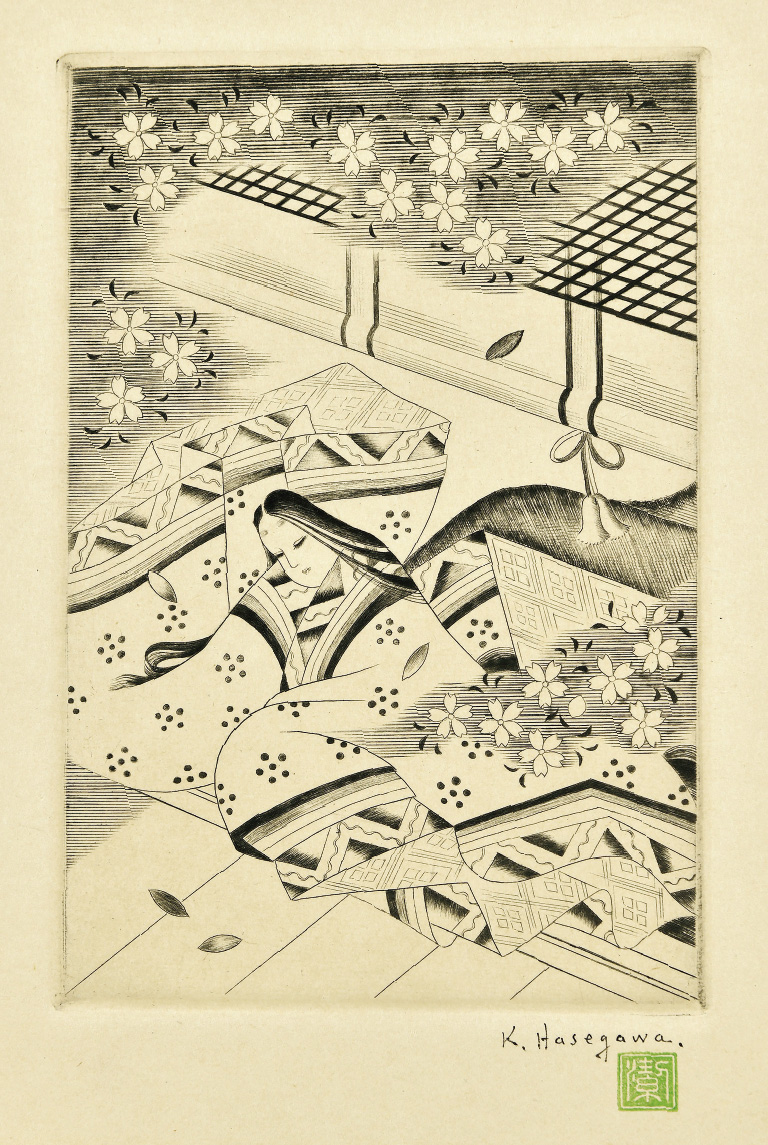
3. The Tale of the Bamboo Cutter: A Japanese Classic Engraved in France

Hasegawa said that it was only after moving to France that he came to appreciate “the dignity of Japan.” He began producing copperplate prints based on Taketori monogatari (The Tale of the Bamboo Cutter) in the late 1920s, and completed an illustrated book in 1933. This section features Hasegawa’s exquisite illustrated book, to which he devoted the closest attention, from the frontispiece and lettering design to the choice of paper.

Trans: Seiichi Motono, The Tale of the Bamboo Cutter (Special Members' Edition of the Société du livre d'art) 1934
Machida City Museum of Graphic Arts

Kiyoshi Hasegawa
Illustration for the chapter “The Suitors’ Proposals”
1927-34/ Engraving, drypoint

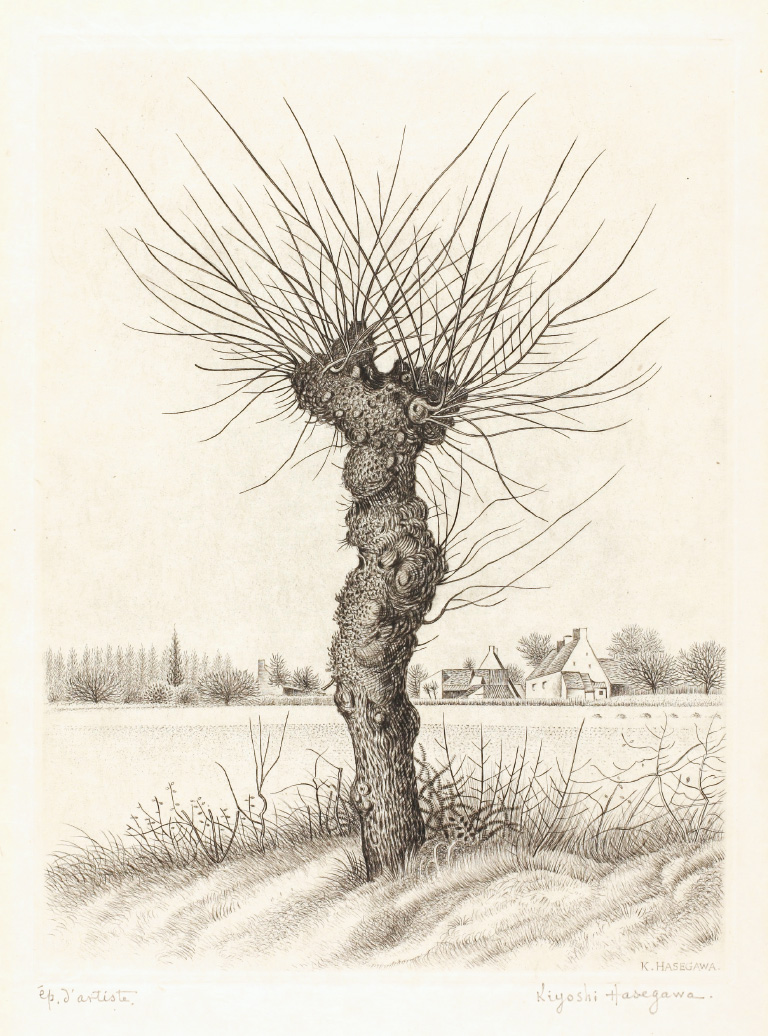
4. Nature: Seeing the Divine in Broad Daylight

Hasegawa remained in France during World War II. He continued his work despite material and emotional hardship, and it was during this time that he came to see even the most ordinary trees and plants as imbued with mystery. This section presents prints from the war years and after in which Hasegawa rendered natural forms in lucid, minute detail.

Kiyoshi Hasegawa
A Tree (Elm)
1941/ Drypoint
Machida City Museum of Graphic Arts

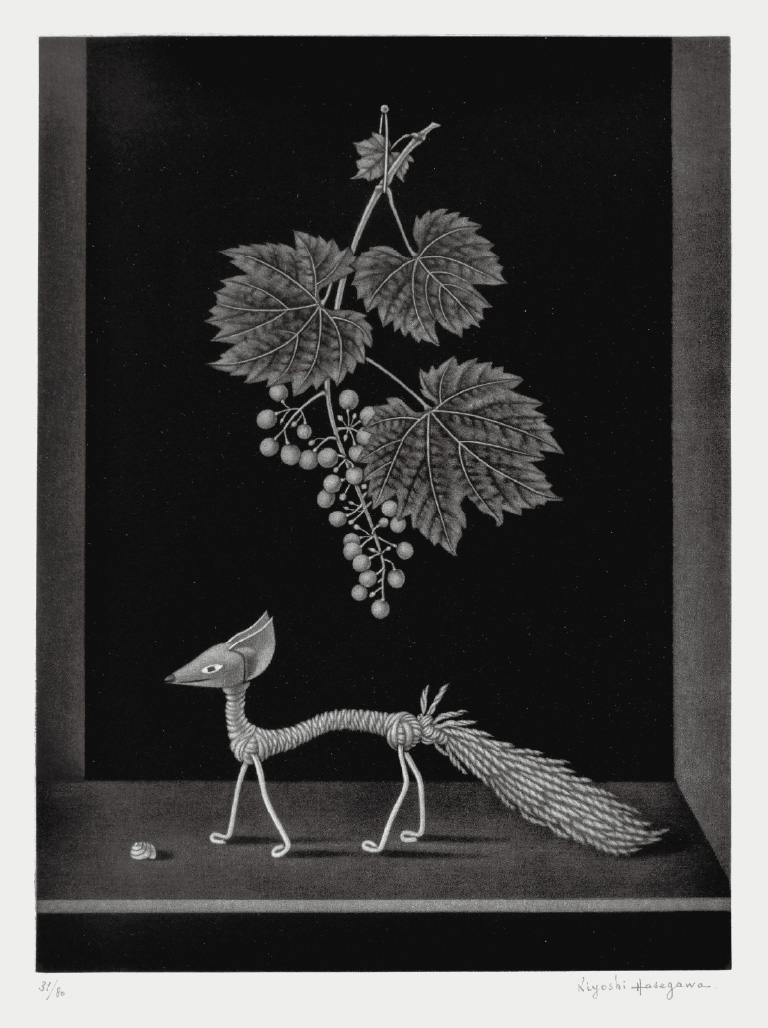
5. Still Life: The Cosmos of Manière Noire

In the late 1950s Hasegawa returned to traditional manière noire (mezzotint), producing still lifes charged with symbolism set against deep, pitch-black grounds. This section brings together the landmark works of his late years, marking the culmination of an artistic career that endured through turbulent times.

Kiyoshi Hasegawa
Fox and Grapes (Fables of La Fontaine)
1963/ Mezzotint
Machida City Museum of Graphic Arts